Context
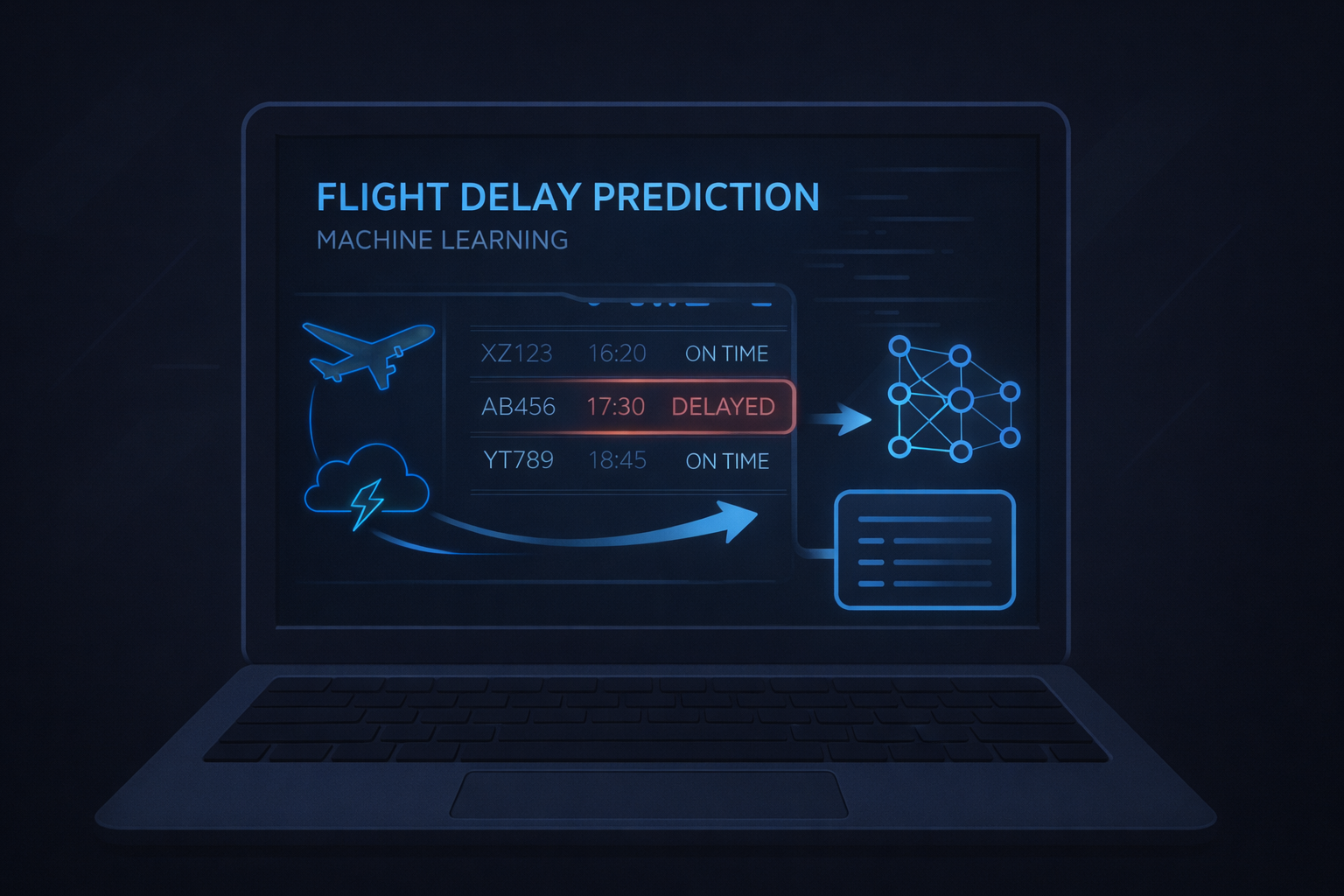
This project implements an end-to-end system for predicting US commercial flight delays using only pre-departure metadata from the US DOT Flight Delays dataset. The model works with information that is available before departure:
- month and day of week
- scheduled departure and arrival hours
- origin and destination airport codes
- airline code
- distance in miles
The goal is to estimate both the probability that a flight will arrive more than 15 minutes late and, if delayed, the expected delay in minutes. On top of the model sits a conversational assistant — the Flight Deck Console — so a user can describe a flight in plain English and get a grounded prediction back with the reasoning behind it.
System architecture
The system is a small pipeline of independent layers, each doing one job:
- Next.js chat UI (
frontend/) — the Flight Deck Console, sending messages to the backend and rendering the conversation. - FastAPI service (
app/) — hosts/predict,/agent/chat,/healthand/model/performance. - Agent layer (
assistant/) — a ReAct loop with tool-calling, driven by Google Gemini 2.5 Flash. - FAISS retrieval — in-memory semantic lookup for airports and airlines.
- LightGBM two-stage model (
ml_pipeline/) — the classifier + regressor that actually produces the numbers.
The whole thing is packaged with Docker / docker-compose so the API and agent come up with a single command.
ML pipeline
The ML pipeline (ml_pipeline/) loads the Kaggle CSVs, cleans and filters the data, and builds features using only pre-flight information:
- removal of cancelled and diverted flights
- explicit dropping of leakage columns (fields only known after departure/arrival)
- time-based features and time slots
- calendar flags (weekend, summer, holiday season)
- cyclic encodings for month, day-of-week and hours
- route and distance categories, hub indicators
- historical delay statistics for routes, airlines and time bands
A two-stage model based on LightGBM is trained:
- a classifier (
LGBMClassifier) that estimatesP(delay > 15) - a regressor (
LGBMRegressor) that predicts delay minutes on delayed flights
Feature engineering runs identically at training and inference time — models, feature statistics and encoding metadata are serialized so there is no train/serve skew.
Agent, RAG and guardrails
The model is exposed through the FastAPI backend and an LLM-powered assistant that turns free-form conversation into a valid prediction request.
- ReAct loop — the agent reasons, calls a tool, observes the result and repeats, bounded to 8 iterations. It has six tools: airport search, airline search, time resolution, distance calculation, slot updates and the model prediction itself.
- FAISS RAG — in-memory indexes over airports and airlines, queried with multilingual embeddings for fuzzy entity resolution ("JFK", "New York", "Kennedy" all resolve to the same code). This grounds every airport/airline code in real data instead of letting the LLM invent one.
- Deterministic slot-filling — the agent fills the 8 required inputs from tool results and enforces a complete slot state before it is allowed to predict.
The loop is deliberately deterministic where it can be: the LLM handles conversation and slot-filling, while distance calculation and the prediction itself are plain tool calls — so the numbers a user sees always come from the model pipeline, never from the LLM's imagination.
Guardrails keep the assistant honest:
- a hard prediction gate — all 8 slots must be filled before any prediction is returned
- no guessing — the LLM is forbidden from inventing airport codes, distances or values
- an 8-iteration bound on the agent loop
- graceful fallbacks when a tool call fails or an entity can't be resolved
Results
The project uses a temporal split (months 1–10 for training, 11–12 for testing), which is honest about the fact that you predict the future from the past.
| Task | Model | Outcome & Notes |
|---|---|---|
| Delayed vs on-time | LGBMClassifier | ROC-AUC ~0.61. Reported with accuracy, precision, recall and F1. |
| Delay minutes (delayed flights) | LGBMRegressor | MAE ~39.8 min. Reported with RMSE and R² against a mean baseline. |
| Entity resolution | FAISS + multilingual embeddings | Robust. Grounds airport/airline codes in real data, no hallucinated codes. |
| Conversation → prediction | Gemini 2.5 Flash (ReAct) | Deterministic. Numbers always come from the model, never the LLM. |
By design, the system relies only on schedule and route metadata. High-signal real-time factors such as weather, airport congestion and gate status are not present in the dataset, which caps the achievable performance; this is partially mitigated by historical aggregates on routes, airlines and time bands.
What I'd do next
- More robust temporal cross-validation and probability calibration.
- Higher-signal features (weather, airport congestion, real-time gate status) when available.
- Persistent session state (Redis) instead of in-memory, and a persisted FAISS index instead of rebuilding at startup.
- Streaming agent responses and a richer chat frontend.
- Structured logging and conversation tracing.
- Exposing feature importance in the API response and surfacing the key drivers in the LLM's answer.